

Research-style article
7 Reasons People With ADHD Are Ditching Coffee and Energy Drinks (#3 Explains the 2PM Crash)
Your 4th can of the day isn't a productivity tool. It's a jitter machine with a logo on it[1]. Here's what people describe, what the research actually says (including one tiny study worth knowing about), and the lower-caffeine morning swap some of them are trying.
It's 4 PM. Cold brew at 8. Energy drink at 1. Your leg is bouncing, your heart is doing its own thing, and you've opened the same tab for the third time.
You're wired. You're just not getting anything done.
Some people with ADHD say caffeine is their go-to “focus hack.” And some of them are now quietly quitting it, or at least cutting way back.
Sound familiar? Tap everything that's happened to you this week.
You're not imagining it. The FDA lists jitters, anxiety, an increased heart rate and sleep disruption among the signs of too much caffeine[1]. Here's what people describe, one reason at a time.
The energy-drink industry would love you to think the answer is a bigger can. Look at the labels: a 16oz Monster lists 160mg of caffeine[11], and a 16oz C4 lists 200mg[12]. A single Starbucks Grande Pike Place lists 315-390mg[15], which is most of the 400mg a day the FDA cites as not generally associated with negative effects for most adults[1]. And that's before your second drink.
This isn't a “caffeine is evil” article. Caffeine is fine for most adults in moderate amounts, and sensitivity varies a lot from person to person[1]. But “moderate” and “three cans by dinner” aren't the same thing.
STILL™ is built for mornings with 40 tabs open. It's about 50mg of caffeine from matcha, plus 6 mushrooms[9]. Here are 7 reasons some people are switching, and what the research actually says.
STILL™ is a food product, not a treatment for ADHD or any condition.
What the research found
The tiny study that got people talking (caffeine alone vs. caffeine + L-theanine)
In 2020, Kahathuduwa and colleagues (Scientific Reports) gave 5 boys with ADHD (ages 8-15) four different drinks on separate days: caffeine, L-theanine (an amino acid found in tea), both together, or a placebo[7]. Caffeine alone made one measure of impulse control worse (stop-signal reaction time)[7]. The caffeine + L-theanine combo improved overall cognition scores and accuracy on one attention task, and showed a non-significant trend toward better impulse control[7].
The fine print:
1. The jitters show up first.
Shaky hands. Heart going like it's late for something. Thoughts moving at 200mph and getting absolutely nowhere.
This is the part the can doesn't put on the front. The FDA lists jitters, anxiety, a racing heart and heart palpitations among the signs of too much caffeine[1]. In a 1997 double-blind study in the Journal of Clinical Pharmacology, Kaplan and colleagues gave healthy adults either 250mg or 500mg of caffeine. At 500mg, people reported more tension, nervousness, anxiety, irritability and restlessness, and performance actually improved less than it did at the lower dose[2].
Read that again: past a point, more caffeine bought them a smaller performance boost. And 500mg is about two and a half 16oz C4s[12].
More caffeine. Smaller payoff.
2. The anxiety spiral is real (for some people)
Some people say the morning cup turns into a 10 AM worry spiral.
In a 2022 systematic review and meta-analysis in General Hospital Psychiatry, Klevebrant and Frick found that high caffeine doses (400-750mg, roughly 5 cups of coffee) triggered panic attacks in about half of people with panic disorder. At those doses, caffeine raised anxiety in healthy adults too[3]. The authors are clear that much less is known about smaller doses[3].
Two Grande brewed coffees can already land you in that 400mg+ range[15]. That's not a ritual. That's a dare.
Same cup, different person. Your sensitivity counts.
3. The 2 PM crash (and the “fix” that makes it worse)
Here's the scam: caffeine up, crash, more caffeine, repeat. The “fix” for the crash is the same thing that set you up for it.
Part of it may be withdrawal. In a 2004 review in Psychopharmacology covering 66 studies, Juliano and Griffiths found that going without caffeine can bring fatigue, low energy, drowsiness, trouble concentrating, irritability and “foggy” thinking, usually starting 12-24 hours after your last dose[4].
The “fix” for the crash is the thing that set it up.
Matcha plus 6 mushrooms. About $1.08 a cup with the Ritual Duo subscription. Free US shipping.
4. The “I literally can't function without it” trap
Here's what nobody prints on the can: in the same review, withdrawal symptoms showed up even after stopping doses as low as 100mg a day, and they were generally worse at higher daily doses[4]. A 16oz Monster alone is 160mg[11].
So the “I can't function without it” feeling may partly be the caffeine talking.
Cutting back fast can bring those symptoms on, so step down gradually.
“Can't function without it” may be the caffeine talking.
5. “Wired but not really there”
This is the one people struggle to put into words. Buzzing body, foggy head. Awake but weirdly detached, like watching your day through glass.
Honest version: research here is thin. High-dose caffeine is linked to unpleasant over-stimulation[2], and a published case report describes caffeine making depersonalization symptoms worse in one patient[5]. One case is a story, not proof. But if this sounds familiar, notice how much caffeine you've had that day, and tell your doctor.
Notice it. Write it down. Tell your doctor.
6. Your sleep pays the bill
The 3 PM energy drink feels harmless at 3 PM. At 1 AM, it's less cute.
In a 2013 study in the Journal of Clinical Sleep Medicine, Drake, Roehrs, Shambroom and Roth found that 400mg of caffeine taken even 6 hours before bed significantly disrupted sleep compared with placebo[6]. Their advice: skip substantial caffeine for at least 6 hours before bed[6].
Bad sleep, then a groggy morning, then a bigger coffee, then worse sleep. Congrats, you're subscribed to a loop you never signed up for.
Today's 3 PM can is tonight's 1 AM ceiling.
7. Matcha brings caffeine AND L-theanine
Here's the swap some people land on: matcha.
Matcha is a powdered Japanese green tea, and it naturally contains both caffeine and theanine[8].
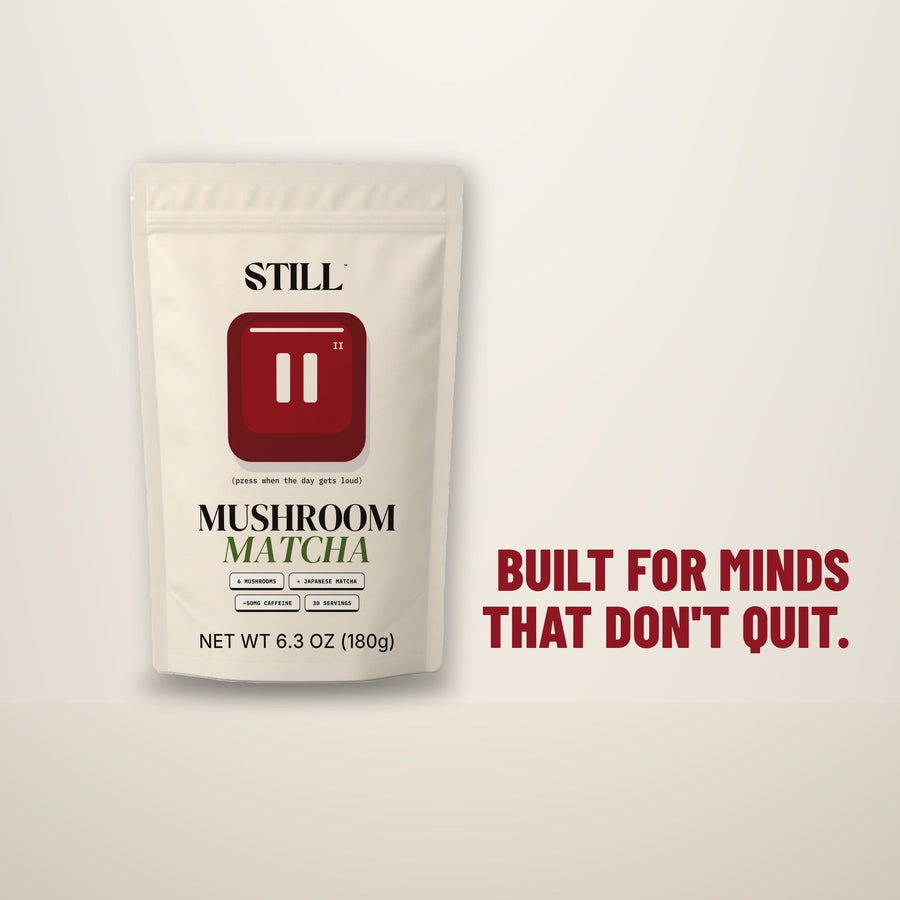
STILL™ Mushroom Matcha:
- About 50mg caffeine per serving[9]
- Premium Japanese matcha plus 6 mushrooms: Cordyceps, Reishi, Turkey Tail, King Trumpet, Shiitake and Lion's Mane[9]
- 250mg of mushrooms per serving (7,500mg per pouch, 30 servings)[9]
- USDA Certified Organic (certified by CCOF)[9]
- Made to support steady, everyday energy.* (Cordyceps is traditionally used to support energy.*)
As each brand lists it: Red Bull 80mg per 8.4 fl oz can[13] · Monster Energy Original 160mg per 16 fl oz[11] · CELSIUS 200mg per can (12 oz cans)[14] · C4 Energy 200mg per 16oz can[12] · Starbucks Pike Place Grande 315-390mg per 16 fl oz[15].
About 50mg caffeine, and the matcha brings its own theanine.
Your new morning, about 50mg at a time.
Built for mornings with 40 tabs open.
Here's the per-cup math: about $1.08 a cup with the Ritual Duo subscription, vs. 315-390mg of caffeine in one Grande brewed coffee[15]. About $1.08 a cup, and way less caffeine.
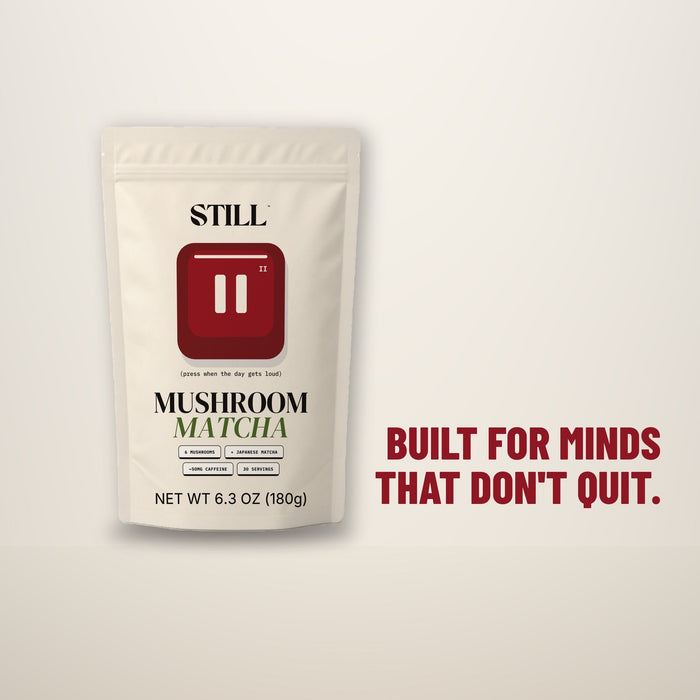
The Ritual Duo (Subscribe & Save) SAVE 19%
- 2 pouches = 60 servings
- $64.79 per delivery (about $1.08 a cup), shipped every 2 months by default (you can change the delivery frequency)
- Free US shipping
- 30-day money-back guarantee, even if opened, and we cover return shipping
- Cancel anytime (cancel by email or the contact form)
Just want to try it? The Daily Ritual, 1 pouch (30 servings): $37.99 one-time. Get a single pouch →
What people say on getstill.us[10]
Reviews are about taste and routine.
“I've been trying to cut down on coffee and this made it way easier than I expected. Plus it actually tastes good.” (Customer review)
“I've been making this before my morning classes instead of grabbing an energy drink. Love the taste and it's become part of my routine.” (Verified buyer)
“Been using this instead of my second cup of coffee in the morning. Tastes way better than I expected.” (Customer review)
★ 4.3 from 400+ reviewsUSDA Organic (CCOF)Free US Shipping30-Day Money-Back Guarantee
Allergen: contains tree nuts (coconut).
The “Even If You Opened It” Guarantee
Try it for 30 days. If it's not for you, you get a full refund, even if the pouch is open. That covers one-time orders AND subscriptions.
And yes, we cover return shipping. The only way to lose is to keep buying the drink you're already sick of.
The 30-day clock is the only clock on this page. Start it now and you'll know before your next month of coffee runs is paid for.
FAQ
Does STILL™ treat or help ADHD?
No. STILL™ is a food product. It isn't a treatment for ADHD or any condition, and it isn't a replacement for medication. Don't change or stop any prescribed treatment without your doctor.
How much caffeine is in it?
About 50mg per serving[9]. For context, the FDA cites 400mg a day as an amount not generally associated with negative effects for most adults[1].
I'm sensitive to caffeine, or I take ADHD medication. Can I drink it?
It still contains caffeine, so ask your doctor or pharmacist first, especially if you take a stimulant or any other medication. The FDA notes that medications, health conditions and individual sensitivity all affect how much caffeine is too much[1].
How much L-theanine is in it?
Matcha naturally contains theanine[8], but we haven't published a verified per-serving amount, so we won't make one up.
Will I crash?
Everyone reacts differently, so we can't promise how you'll feel. What we can tell you: STILL™ has about 50mg caffeine per serving[9], less than many energy drinks and big coffees. As listed by each brand, an 8.4 fl oz Red Bull has 80mg[13], a 16 fl oz Monster has 160mg[11], a CELSIUS can has 200mg[14], a 16oz C4 has 200mg[12], and a Starbucks Grande Pike Place has 315-390mg[15]. If it's not for you, it's covered by the 30-day money-back guarantee.
Does it taste like mushrooms?
Customers keep saying no. One review: “The biggest surprise is that it doesn't taste like mushrooms at all. It's just a smooth earthy matcha.”[10] Some find it earthy plain, and many reviewers like it with milk, oat milk or iced[10].
How does the subscription work?
The Ritual Duo ships every 2 months by default (you can change the delivery frequency) at $64.79 per delivery, with free US shipping. Cancel anytime. Cancel by email or through our contact form.
What's in it besides matcha and mushrooms?
The label also lists organic MCT oil, coconut milk, blue spirulina and Himalayan pink salt. Contains tree nuts (coconut).
About 50mg caffeine. Not 200.★ 4.3 · 400+ reviews · ~$1.08/cup · 30-day money-backSwap the 4th energy drink for about 50mg of matcha + mushrooms. ★ 4.3 (400+ reviews) · Free US Shipping · 30-Day Money-Back
Try STILL™ →Get the Ritual Duo →